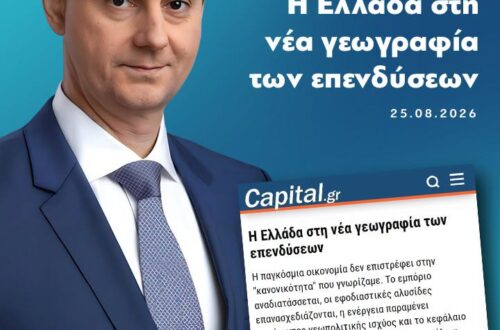
Deputy Minister of Foreign Affairs Harry Theoharis refers to Greece’s role as a pillar of stability and a reliable hub between West and East, stressing that in recent years the country has proven that it can respond to successive crises.
In an interview with ethnos.gr, he focuses on a series of moves that have unfolded and underlines, among other things, that measures are being taken to protect citizens from profiteering. As regards migration, he notes that Greece is today better organised than ever.
“From the very first moment we moved with speed and determination, supporting Cyprus in practice and strengthening our defensive presence in the eastern Aegean,” he says, adding that “Greece is playing a leading role and actively contributing to shaping a common European stance at a particularly critical juncture.” As regards the repatriation of Greek citizens from countries of the Middle East, the number has so far reached 2,800.
Answering a question on the findings of the latest opinion polls, Mr. Theoharis underlines that citizens assess reality and see who can effectively manage critical situations. “In a period of international instability, political stability and decisive leadership become even more important,” he stresses.
– The outbreak of war in the Middle East is creating new circumstances, and no safe predictions can be made about how long the “conflagration” will last. How is Athens positioning itself in the face of the rapid developments of recent weeks?
“Greece’s stance is reflected in the actions of the government of Kyriakos Mitsotakis. From the very first moment we moved with speed and determination, supporting Cyprus in practice and strengthening our defensive presence in the eastern Aegean.
Greece is playing a leading role and actively contributing to shaping a common European stance at a particularly critical juncture. At the same time, we remain firmly in favour of peace and diplomacy as means of resolving differences, in a war whose duration and course no one can predict.”
– The war in the Middle East is affecting a number of areas, such as the economy, energy, shipping and possibly, at a later stage, migration. How well protected is the country to deal with the serious consequences that may arise?
“The situation is causing understandable concern, which is why Greece is acting in full coordination with the European and international community. At the same time, we continue to strengthen our economic diplomacy and our partnerships in the Middle East.
Until shortly before the start of military operations, significant agreements had been signed with countries in the region — for example, 21 memoranda of cooperation with Libya, as well as synergies with the United Arab Emirates, Iraq and other countries.
Obviously, war does not favour business activity. However, these partnerships confirm Greece’s role as a pillar of stability and a reliable hub between West and East. In recent years, the country has proven that it can respond to successive crises, while measures are also being taken to protect citizens from profiteering. As regards migration, Greece is today better organised than ever.”
– Regarding the repatriation of Greeks who are in the Middle East, what do the latest figures show?
“This is a particularly complex and demanding operation. In essence, we are evacuating our fellow citizens from a wide conflict zone, across many different countries and with serious restrictions on international flights.
Despite the difficulties, the operation is proceeding smoothly so far, and approximately 2,800 Greeks have been safely repatriated from countries such as the United Arab Emirates, Israel, Qatar, Kuwait, Bahrain and Oman.”
– A debate on European defence and the steps that need to be taken is under way. Can the European “shield” in Cyprus provide the impetus for bolder decisions on this critical issue?
“I hope it will be an important step in that direction. The trilateral meeting in Cyprus between Kyriakos Mitsotakis, Nikos Christodoulides and Emmanuel Macron was of particular significance.
The European operation EUNAVFOR ASPIDES for the protection of shipping in the Red Sea moves in the same spirit. These are examples of coordinated European action that can pave the way for a stronger European defence policy.”
– Türkiye shows that it is not abandoning its high-pitched rhetoric and insists on the demilitarisation of the islands, while it has also sent six F-16s to the occupied areas. In a complex geopolitical landscape, do you expect Ankara to try to “stir up” Greek–Turkish relations, or, despite individual moves, is it interested in keeping open channels with Athens?
“Türkiye has always tried to play on many “boards” at the same time: on the one hand it maintains a climate of tension, and on the other it declares itself open to dialogue.
As regards the demilitarisation of the islands of the Eastern Aegean, however, there is no room for discussion. Greece has a full and inalienable right, under international law, to strengthen the defence of its islands. This is our sovereign right.”
– The latest opinion polls — conducted after the new circumstances created by the war in the Middle East — show the governing party’s ratings rising. Do you think the stability argument put forward by the government is rallying voters who had voted for New Democracy in the previous elections but later moved into the pool of undecided voters?
“Citizens assess reality and see who can effectively manage critical situations. In a period of international instability, political stability and decisive leadership become even more important.
The government of Kyriakos Mitsotakis has proven that it can take swift and responsible decisions when circumstances require, defending the national interest.”