By Harry Theoharis, Deputy Minister of Foreign Affairs responsible for Economic Diplomacy and Extroversion
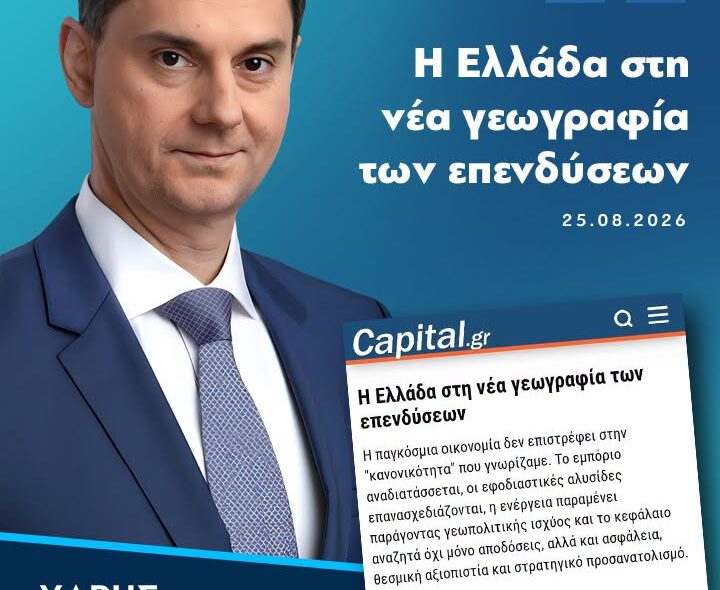
The global economy is not returning to the “normality” we knew. Trade is being realigned, supply chains are being redesigned, energy remains a factor of geopolitical power, and capital is seeking not only returns, but also security, institutional credibility and strategic orientation.
This is the new environment in which Greece is called upon to operate. And the response of the government of Kyriakos Mitsotakis is clear: the country will not be a spectator of developments. It will be an active player in the new geoeconomics.
In this context, economic diplomacy takes on a different weight. It is not public relations. It is not participation in trade fairs without follow-up. It is not general promotion of the country. It is a mechanism of national competitiveness. It is the way in which we connect foreign policy with investment, exports, infrastructure, innovation, regional development and productive upgrading.
Greece today has one key advantage: credibility. This was not a given. It was earned through political stability, fiscal consistency, reforms, the digital transformation of the state and a continuous effort to restore trust. The European Commission estimates that the Greek economy grew by 2.1% in 2025 and forecasts growth of 1.8% in 2026, with investment remaining a key supporting factor, while public debt is projected to fall to close to 134% of GDP by 2027.
This credibility is now translating into investment results. Net inflows of Foreign Direct Investment reached €11.38 billion in 2025, compared with €7.02 billion in 2024, an increase of 62.2%. In the first four months of 2026, inflows amounted to €4.4268 billion, compared with €2.3183 billion in the same period of 2025, an increase of 90.9%.
Similarly, goods exports in the five months from January to May 2026 amounted to €22.9 billion, up 13.5%. Exports excluding petroleum products rose by 4.5%, while the trade deficit fell by 9.0%. These figures should not be read in isolation. They show that extroversion is now becoming an organic element of the new productive model.
What matters, however, is not to celebrate numbers. It is to turn them into a permanent productive advantage. Because Greece does not simply need more investment. It needs better investment. Investment that brings technology, know-how, export capacity, quality jobs, innovation and connection to international value chains. It is not enough for the capital entering the country to increase. Its footprint on productivity must increase too.
The Strategic Plan for Extroversion 2026-2030 is part of this logic. It is a practical policy tool, not a theoretical text. It sets geographical and sectoral priorities, strengthens the role of the Ministry of Foreign Affairs, the Economic and Commercial Affairs Offices, Enterprise Greece and Export Credit Greece, and links investment with exports in a single framework. The Plan was approved by the Government Committee on Extroversion, and its immediate aim is to attract high-impact investment, boost entrepreneurship and create new jobs.
At the same time, we are building bridges with the market. Cooperation with the Athens Chamber of Commerce and Industry (EBEA), the Panhellenic Exporters Association, the Regions and productive stakeholders is not a formality. It is a necessity. Economic diplomacy must start from the real needs of businesses: information, market access, financing tools, risk management, timely preparation and substantive support. The memoranda of cooperation signed by the Ministry of Foreign Affairs with EBEA and the Panhellenic Exporters Association move precisely in this direction.
The same spirit governs the initiative for the participation of Greek businesses in World Bank projects. There, the goal is clear: not merely to inform businesses about international tenders, but to help them prepare better, build partnerships and compete on equal terms in energy, water, infrastructure and reconstruction projects.
The new geography of investment favours countries that combine stability, a strategic location and the capacity to deliver. Greece has all three. It lies at the meeting point of Europe with the Eastern Mediterranean, the Balkans, the Black Sea and the Middle East. It has an upgraded geopolitical role, an improved investment environment and a government that understands that growth cannot rely solely on consumption, but on production, innovation, exports and investment.
The challenge of the day after is delivery. Less bureaucracy, better coordination, faster decisions, more effective tools for businesses. Investors do not ask for perfection. They ask for predictability, continuity and seriousness.
This is exactly what we are building. A Greece that does not merely ask to be trusted, but proves that it deserves trust. A Greece that does not limit itself to attracting capital, but turns it into production, exports and national strength.
In a changing world, our country has the opportunity not to remain on the periphery of developments — to find its place on the map of the credible, outward-looking and competitive economies of the new era. This is our goal. And we serve it with a plan, consistency and confidence.