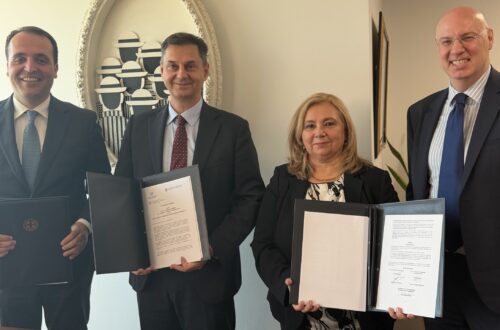
Deputy Minister of Foreign Affairs Harry Theoharis talks to “Manifesto” about how the government is proceeding with fiscal responsibility, which gives it the opportunity to return a dividend to citizens.
He refers to the National Extroversion Strategy and its targets, and analyses the progress in attracting investors.
He considers that in New York Greece sent the message that it is leaving the period of uncertainty behind for good and now presents itself as a country that combines steady growth, investment attractiveness and a clear plan for the future.
He also commented on New Democracy’s lead in the polls, as well as on the governing party’s responsibility to further improve citizens’ lives, above all by tackling the everyday cost of living.
How do you ensure that the announced tax cuts will not affect the country’s fiscal stability, especially given inflationary pressures and increased spending?
Our strategy since 2019, when we took over the governance of the country, has been clear: to change Greece. It rests on two fundamental principles — fiscal responsibility and reforms that strengthen competitiveness. These principles are what allow us to cut taxes safely and return a growth dividend to citizens.
From the years of uncertainty and the memoranda, we have moved into a period of growth, successive tax cuts and restored credibility abroad. The reforms were not piecemeal, but part of a coherent plan that supports society, strengthens the middle class and creates prospects for the future.
The tax relief announced is therefore part of an overall strategy, constituting the largest tax reform since the restoration of democracy. It rests on three axes: supporting the family and addressing the demographic challenge, strengthening the middle class that bore the burden of the crisis, and reinforcing social cohesion with measures for pensioners, uniformed personnel and vulnerable groups.
Our country now records fiscal surpluses and is rapidly reducing public debt, which makes it an exception to the European rule. This allows us to cut taxes without disturbing the stability of the economy. Consequently, the tax cuts not only do not threaten fiscal balance; they strengthen it.
How will you ensure that the reduction in the tax scale actually reaches those who really need it and does not remain a benefit only for those who already have higher incomes?
The government chose to reduce direct taxes. It reduced the tax rates that concern our young people, the middle class and our most vulnerable fellow citizens. It also reduced property taxes — that is, ENFIA — for border areas, as part of a clear strategy of support for young people, the family and balanced regional development.
Cuts in direct taxes, compared with cuts in indirect taxes such as VAT or excise duties and so on, have the characteristic that they pass automatically and in full into the incomes of the citizens they are aimed at.
By contrast, the Bank of Greece shows that, based on Greek experience, only about 20% of such a reduction passes through to the final consumer. Let us note that this happens through a lawful process, as there are no price controls on products. The measures announced at the Thessaloniki International Fair, once activated in January, will therefore start to show up automatically in the pockets of employees and pensioners, and will pass to the other categories of taxpayers through their tax returns.
What are the main objectives of the National Extroversion Strategy?
The National Extroversion Strategy, recently approved by the Government Council for Economic Policy, is the new national framework that sets clear priorities and measurable targets for increasing exports and strengthening the country’s international presence. Our goal is to create the conditions for Greek businesses to become more competitive, more innovative and more dynamic in global markets.
The Government Committee on Extroversion is being institutionalised, for better coordination of the co-competent ministries and for monitoring and evaluating the implementation of policies. We are laying the foundations for more effective promotion of Greek products and services, with an emphasis on opening up to new markets and strengthening our country’s brand internationally.
We are carrying out a substantial transformation of Enterprise Greece into a modern one-stop shop for exporters and investors, through innovative actions.
We provide specialised services in sectors where Greece has comparative advantages and are developing a more flexible organisational structure with broad sectoral and geographical coverage. At the same time, we are implementing an evaluation system and strengthening businesses’ access to new financing tools, supporting investment and liquidity.
We are proceeding with the transformation of Export Credit Greece, in full alignment with the European framework. We aim to use a reserve of €1.43 billion to support businesses. Our cooperation with the European Investment Bank is also of particular importance, through which we are proceeding with the assessment and financing of investments, having already signed a relevant memorandum of cooperation.
With a 2030 horizon, our new National Strategy aims at increasing exports by €8 billion, attracting investment of €3 billion and creating 180,000 new jobs.
We are thus proving that extroversion is not a general declaration, but a national policy with depth, duration and measurable results.
Is there progress in attracting investment to Greece, and in which sectors?
In recent years, Greece has recorded an impressive rise in attracting foreign investment, with record performances that are internationally recognised and strengthen the country’s position on the international investment map. The country has significantly improved its investment environment, which is reflected both in the increase in foreign direct investment and in the upgrading of the international image of our economy.
Investment is being directed into sectors of strategic importance, such as Renewable Energy Sources and offshore wind, energy storage and green hydrogen, digital technology and telecommunications, the supply chain and logistics, and high value-added tourism.
At the same time, we are seeing significant interest in pharmaceuticals and agri-food, two sectors linked to innovation and extroversion. The fact that Greece is recording successive records in foreign investment projects confirms that the reforms are bearing fruit. Our goal is for these investments to be lasting, to strengthen the productive base and to create stable, quality jobs.
Over the last six years we have attracted foreign direct investment exceeding €30 billion, while over the previous twenty years the corresponding figure was below €30 billion.
According to a recent EY study, almost half of the investments made since 2000 took place in the last five years. In 2023 alone, 50 new FDI projects were implemented — the best performance since 2000 — while 58% of foreign companies say they plan to expand or start operations in Greece, the highest percentage ever recorded.
This progress is not accidental. It reflects reforms that have improved the investment environment and made Greece a more attractive and competitive destination for investment capital internationally.
Our goal is for investment to exceed 20% of GDP and to contribute further to strengthening quality employment and the resilience of the Greek economy.
You were in New York for the UN General Assembly. What did you take away from your contacts?
In New York, the strong message emerged that Greece is leaving the period of uncertainty behind for good and now presents itself as a country that combines steady growth, investment attractiveness and a clear plan for the future.
This was very clear both in the meetings where I accompanied the Prime Minister and in one-to-one meetings. We presented the opportunities Greece offers in the new economy, highlighted our priorities for sustainable and resilient global growth, and I held contacts with investors, funds and international partners. The strong interest we encountered in our country’s successes confirms that Greece is today an attractive and reliable destination in the international investment environment.
It is clear to all investors that our country is a rare example of a state that has put its public finances in order. This offers assurance that the rules of the game will not change, as investors know that countries with fiscal difficulties — such as France at present — often make sudden changes to taxation and market regulation.
How do you comment on the recent polls? Will the Prime Minister’s announcements at the Thessaloniki International Fair change the climate?
Polls are a useful tool, because they capture the mood of society and show where we need to focus more. Their main message is twofold: on the one hand, New Democracy maintains impressive stability and a clear lead for a second consecutive term. On the other, our citizens are asking us to intensify our efforts in their daily lives, with the cost of living at the forefront.
The country has achieved high growth rates, investment and reforms that are changing the productive model. But citizens want to see the benefits reach their own incomes faster and more tangibly. That is the real challenge.
The interventions announced at the Thessaloniki International Fair serve exactly this purpose. They are not piecemeal measures, but part of a coherent plan that strengthens young people, families and local communities. The battle for stability and a single-party majority will be decided by the consistency and speed with which we implement this strategy.
Our main job is not to watch the polls, but to advance reforms. In the second half of the year the government has scheduled 25 reforms; the ministries have committed to them, and they will proceed at a rate of four a month, or one a week. In the end, this will allow us to say that we did what we said. We have the responsibility and the determination to prove that Greece can move forward with a strong economy, social cohesion and confidence in the future.