
As the minister responsible for economic diplomacy and extroversion, what did you take away from your meetings with representatives of productive and exporting bodies in Thessaloniki, on the occasion of the Thessaloniki International Fair?
On the occasion of the Thessaloniki International Fair (TIF), I had the opportunity to meet representatives of productive and exporting bodies and to discuss with them the challenges exporting businesses face in today’s international environment, as well as the opportunities that are opening up. I keep three points from our meetings:
first, Northern Greece remains a hub of extroversion, with dynamic businesses seeking new markets;
second, strengthening competitiveness requires a stable and predictable environment, which is a strategic choice of the government; and
third, there is a strong willingness among these bodies to cooperate with the State in order to make use of the new tools introduced by the National Extroversion Strategy.
We discussed in detail the changes promoted by the National Extroversion Strategy and the prospects opening up through the transformation of Enterprise Greece, the reform of Export Credit Greece and the introduction of digital tools.
These bodies now see TIF not simply as a showcase opportunity, but as an opportunity for strategic dialogue with the State; this maturity is extremely important. Businesses are asking for real-time solutions — from simplifying customs procedures to better networking with international markets. And this is exactly what we are incorporating into the new five-year plan for extroversion: actions that start at the operational level and result in measurable outcomes in exports.
Thessaloniki and Northern Greece as a whole are at the heart of this effort. That is where industry meets innovation, and universities meet exporting businesses. Our challenge is to turn this ecosystem into a real lever for strengthening business competitiveness.
That is why the meetings at TIF were valuable: on the one hand they gave us a clear picture of the needs, and on the other they showed us that these bodies are ready to support and make use of the new tools.
Will the National Extroversion Strategy approved by the Government Council for Economic Policy change the export landscape?
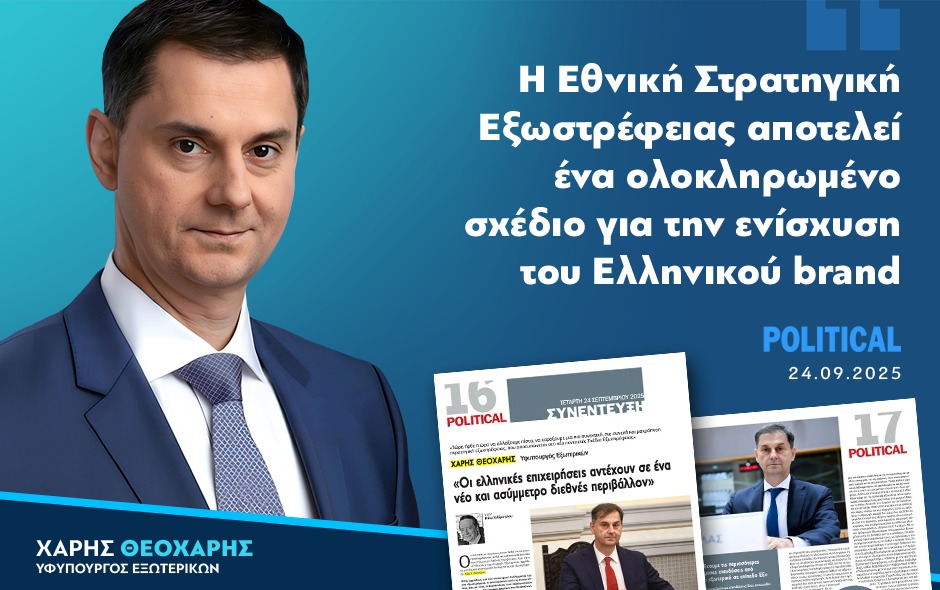
The National Extroversion Strategy, approved by the Government Council for Economic Policy, is a comprehensive plan for strengthening Greece’s brand and the competitiveness of the Greek economy internationally.
To achieve this, we are strengthening coordination between bodies and ministries, promoting closer public–private partnership, setting measurable targets, simplifying procedures and offering financing tools.
An important role in this strategy is played by the transformation of the bodies supervised by the Ministry of Foreign Affairs, Enterprise Greece and Export Credit Greece.
Enterprise Greece is being transformed into a comprehensive extroversion hub, with the aim of providing specialised support services to exporters — training, personalised information and guidance, connection with partners, and facilitating participation in business missions and international exhibitions. It is also acquiring a new, more effective organisational structure with the active involvement of the private sector.
At the same time, we are reforming Export Credit Greece to help companies manage the risks associated with exporting goods and services.
I have kept for last the innovative actions to strengthen the country’s brand:
• Greek Houses, modelled on EATALY, will promote multi-purpose venues for gastronomy, culture and Greek products;
• byGreece will be a single marketplace for all exporters with advertising services; while
• myGreece will concern certified quality products with specific standards, aiming to highlight quality as the main ingredient of the Greek economy.
Are Greek businesses adapting to the new and asymmetric international environment?
Greek businesses have shown that they are not only adapting, but also withstanding a new and asymmetric international environment.
Our exports have reached historically high levels over the last five years, while more and more small and medium-sized enterprises are methodically turning to new markets. This means there is flexibility, an outward-looking mindset and a willingness to invest in innovation and quality.
We saw this clearly at this year’s TIF: from technology start-ups to traditional food industries, there is a willingness to make use of new technologies, artificial intelligence and green production solutions. This shows that adaptation is not simply a defensive reaction to international challenges; it is a strategic choice of differentiation. Greek businesses understand that extroversion and innovation go together — and that is exactly what our policies aim at.
The State, for its part, supports this adaptation with specific additional tools: the Export Academy and the Extroversion Observatory, which strengthen knowledge and transparency.
So the answer is categorical: Greek businesses are adapting. What they need is what we are bringing with the National Extroversion Strategy — a stable environment, institutional coordination and access to modern tools. In this way, their adaptation becomes a comparative advantage for the Greek economy.
How does economic diplomacy help businesses that wish to spread their wings and operate abroad? What has changed here since 2019?
Since 2019, economic diplomacy has stood by business people who wish to operate abroad. Through a network of actions, it strengthens the presence of Greek businesses in international markets. Clear proof of this is the significant increase in exports of goods and services, from €72.5 billion in 2019 to €100 billion in 2024.
For coordinated support of Greek entrepreneurship, we institutionalised as early as 2019 the preparation of the National Strategic Plan for Extroversion. This roadmap summarises the country’s extroversion policies each year and is the result of our cooperation with other ministries, the Regions, business associations and chambers. Now the time has come to move to the next level, to chart a more coherent, more consistent and long-term extroversion strategy. This is reflected in the new five-year Extroversion Plan.
An important role in networking Greek businesses is played by their presence at international trade fairs and missions. In the last six years, business missions have been organised to the Far East and the Middle East, Europe and the Balkans. With the new 2026-2030 Plan, targeting of sectors and countries becomes more specific, so as to increase exports by €8 billion by 2030.
Large enterprises export roughly at the European average, while medium-sized and small enterprises, which account for 99% of Greek businesses, export much less. With the new “SME Extroversion” Programme, we will help them strengthen their export orientation and improve their competitiveness and international presence.
For more effective coordination of actions, we have ensured that the Extroversion Council, with representatives of the Ministry of Foreign Affairs, business associations and chambers, convenes every quarter. Indeed, with the new National Extroversion Strategy, the Council is being upgraded, as the Government Committee on Extroversion is being institutionalised with the participation of representatives of co-competent ministries, because extroversion requires cross-sectoral cooperation.
At the same time, Extroversion Offices have started operating in the Regions. These offices can be a substantial tool for supporting local businesses in promoting local products in international markets, as well as for attracting investment that will strengthen local development. After all, our government’s priority is to strengthen the incomes of local communities by creating new opportunities, new jobs and development prospects.
In short, since 2019 economic diplomacy has been working systematically to support outward-looking entrepreneurship and to make effective use of opportunities in international markets. Today, our strategy is gaining a new framework and new dynamism, responding to the demands not only of the present but also of the future.
Are we attracting investment? Has progress been made here?
Strengthening the country’s international footprint has created a favourable environment for Greek business and for attracting investment, with an emphasis on the green and digital transition.
Over the last six years, Foreign Direct Investment has moved at historically high levels and has shown unparalleled resilience during successive international challenges. We have the most direct investment from abroad at EU level. In 2024, investment reached €6.7 billion, the second-best performance in 20 years, while over the last three years inflows reached almost €20 billion. From the Emirates alone, €4 billion has been invested.
Enterprise Greece has taken on the attraction and reception of so-called Strategic Investments. From June 2019, when the Mitsotakis government took the reins of the country, until December 2024, the Board of Enterprise Greece approved a total of 58 Strategic Investment projects, with a total budget of €9.5 billion, which created 9,100 jobs.
Major multinationals have chosen Greece — Microsoft, Amazon Web Services, Digital Realty and Google in Athens; Pfizer and Cisco in Thessaloniki — to set up Research and Data Centres, confirming our country’s growing role as an investment hub. Let us not forget that our country’s geostrategic position between Europe, Asia and Africa, combined with the dynamism of the digital transition, makes it an ideal hub for developing data centres and cloud infrastructure.
At the same time, a series of investments serve sustainable development, such as that of Fraport Greece, which has undertaken the upgrading of 14 regional airports in the country, or Volkswagen, which partnered to turn Astypalaia into the first smart and green island in the Mediterranean.
Our country’s emergence as an attractive investment destination is a reality, and is also attested by the latest EY Greece survey: 48% of respondents plan to develop or expand their activities in our country over the next year, 63% expect Greece’s attractiveness to improve further over the next three years, and 82% consider the policy for attracting international investors effective.
Do the poll findings concern you? What is needed for New Democracy to approach single-party majority levels again?
Polls have value, because they capture the trends in society and remind us of citizens’ priorities. What they clearly show is two things: first, the unprecedented stability and lead of the governing party in a second consecutive term. Second, citizens’ demand that we intensify our efforts in specific areas, above all the cost of living.
Citizens recognise the country’s progress, the high growth rates and the reforms already being implemented. But at the same time, they are asking us to move faster and more decisively to improve their everyday lives. That is where elections are decided: on the extent to which our policies translate into tangible benefits for every household.
The measures announced by the Prime Minister at the 89th TIF go precisely in this direction. These are not piecemeal handouts, but a coherent strategy focusing on three axes: support for young people, support for families and regional development. Our goal is not only to respond to high prices, but to ensure a fairer society and a more competitive economy.
Therefore, polls have value, but the policies themselves and their results have greater value. We have about a year and a half until the elections. Stability and a single-party majority will be decided by the consistency, effectiveness and speed with which we complete our government cycle. It is up to us to prove that New Democracy can combine a strong economy, social cohesion and a national strategy for a stronger and more outward-looking Greece.


